
Construction Equipment Manufacturing: India’s ₹11,000 Crore Push
- November 27, 2026
- Posted by: Amol Kumar
- Category: Industry Trends
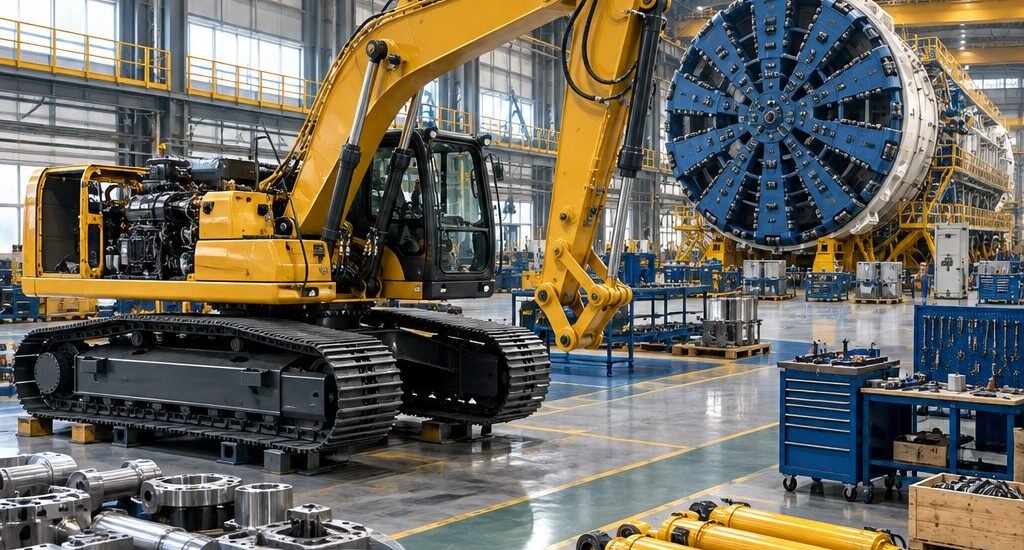
Construction equipment manufacturing has become a strategic industrial priority for India after the Union Cabinet approved an ₹11,000 crore programme to expand domestic production of heavy machinery and critical components. Announced on 25 November 2026, the Scheme for Enhancement of Construction and Infrastructure Equipment (CIE) Manufacturing Ecosystem is designed to address a structural gap: India is one of the world’s largest markets for construction equipment, but a meaningful share of the machines and systems required for major infrastructure projects still depends on overseas supply chains.
The timing matters. Demand for tunnel boring machines, excavators, cranes, off-highway trucks and drilling equipment is rising alongside investment in roads, railways, ports, urban transport, mining and housing. At the same time, new Chinese export controls covering specified tunnelling equipment have brought supply-chain exposure into sharper focus. The policy response is therefore about more than replacing imports. It is an attempt to build domestic engineering depth, improve supplier capability and create a platform from which Indian manufacturers can compete in international markets.
For original equipment manufacturers (OEMs), component suppliers, infrastructure developers and investors, the opportunity is substantial—but it will depend on execution. The scheme’s headline allocation is only one part of the equation. Product qualification, domestic value addition, testing infrastructure, technology ownership, supplier productivity and a credible export strategy will determine whether the programme produces durable industrial capacity.
Construction Equipment Manufacturing Strategy
India’s construction and infrastructure equipment industry is already the world’s third largest, behind China and the United States. The Ministry of Heavy Industries puts the domestic market at approximately ₹97,500 crore in FY2024–25 and projects it to more than double to around ₹2,28,100 crore by FY2029–30. These figures reflect the scale of the opportunity created by infrastructure expansion, but they also raise a strategic question: how much of the value generated by that demand can be retained within India’s industrial base?
The Cabinet-approved scheme seeks to answer that question through a targeted manufacturing intervention. It also fits within a broader push to build domestic industrial capacity, as explored in 6thVeda’s analysis of the India Container Manufacturing Scheme, where scaling local production and developing supplier networks are equally central. Rather than providing a broad subsidy across every category of machinery, it concentrates on high-value equipment and five critical component groups. The design recognises that an industrial ecosystem is not created by assembling a finished machine alone. It requires suppliers that can consistently manufacture engines, transmissions, hydraulic systems, undercarriages and drive systems to demanding performance and reliability specifications.
The programme will run for eight years from FY2026–27. It begins with a two-year period for companies to establish manufacturing facilities, followed by five years of sales-linked incentive disbursement and a final year for settlement of claims relating to the last incentive year. The government has also provided for a dedicated testing facility, acknowledging that domestic production needs domestic validation capacity.
How the Scheme Works
The scheme has two principal components: graded incentives linked to incremental sales by approved manufacturers, and viability-gap support for a specialised testing facility. The distinction is important. The ₹11,000 crore headline outlay is the programme’s overall financial envelope; it should not be interpreted as an unconditional grant available to every company entering the sector.
| Programme element | Current design | Business relevance |
|---|---|---|
| Total outlay | ₹11,000 crore | Signals a multi-year industrial policy commitment. |
| Eligible applicants | Approved OEMs and component manufacturers | Creates an opportunity for both machine makers and specialised suppliers. |
| Sales-linked support | Graded incentives of 8%–13% on eligible incremental sales over five years | Rewards scale-up rather than simply announcing capacity. |
| Facility support | Up to ₹375 crore in viability-gap funding for a dedicated CIE testing facility | Can improve access to product validation and testing infrastructure. |
| Implementation period | FY2026–27 to FY2033–34 | Requires early investment planning and a long-horizon execution model. |
The incentive rates are graded, not a flat 13% payment on every rupee of sales. The detailed operating guidelines will determine the applicable rate, qualifying products, base-year methodology, applicant thresholds, domestic manufacturing conditions and documentation requirements. Companies should therefore model the scheme using conservative assumptions until those rules are published. A project that is commercially viable only under the highest possible incentive rate is not yet a robust investment case.
The Import Gap
The most revealing evidence comes from a written answer provided by the Ministry of Heavy Industries in the Lok Sabha in July 2026. Citing information from the Indian Construction Equipment Manufacturers’ Association (ICEMA), the government estimated that the industry had import dependency of approximately ₹34,500 crore in FY2024–25. Of this amount, fully built construction equipment accounted for about ₹4,250 crore, while nearly ₹30,250 crore related to components and aggregates used in domestic equipment manufacturing.
| Import-dependency category | FY2024–25 estimate | Strategic implication |
|---|---|---|
| Fully built equipment | ₹4,250 crore | Domestic capability is needed in selected high-complexity machine categories. |
| Components and aggregates | ₹30,250 crore | The larger localisation challenge sits deeper in the supplier base. |
| Total estimated dependency | ₹34,500 crore | Import substitution requires both OEM and component-level investment. |
The composition of this figure changes the way the opportunity should be assessed. Component and aggregate imports represent close to 88% of the estimated import-dependency value cited in the parliamentary reply. That does not mean every imported component can or should be localised immediately. Some technologies require specialised materials, precision processes, software, controls or global supplier relationships. It does indicate, however, that the largest industrial prize may lie in developing reliable domestic suppliers rather than focusing only on final assembly.
For investors, this points towards a broader opportunity set: precision castings and forgings, gears, bearings, hydraulic cylinders, pumps, valves, seals, powertrain assemblies, electronic control units and specialised structural parts. Not every category is necessarily covered by the scheme’s final eligibility list. But these capabilities form part of the wider ecosystem required to support competitive equipment production.
The Equipment Priorities
The Cabinet briefing identified seven equipment categories and five component groups for focused support. The equipment categories span machinery used in underground construction, earthmoving, material handling, road and mining-related operations. This is a deliberate mix: some categories have large recurring demand, while others involve high engineering complexity and a smaller pool of qualified global suppliers.
| Equipment category | Potential domestic capability focus |
|---|---|
| Tunnel boring machines | Cutter systems, drives, hydraulic circuits, control systems and machine integration. |
| Off-highway trucks | High-capacity powertrains, braking, chassis, tyres and electronic monitoring. |
| Excavators | Hydraulics, booms, arms, undercarriages, engines and control systems. |
| Cranes | Lifting mechanisms, structural fabrication, winches, transmissions and safety systems. |
| Loaders | Drivetrains, axles, hydraulic systems, attachments and operator controls. |
| Piling rigs | Rotary drives, mast structures, drilling tools and high-pressure hydraulics. |
| Drilling machines | Drill heads, feed systems, power units, control electronics and wear components. |
The five component groups—engines, transmission systems, hydraulic systems, undercarriages and drive systems—are particularly important because they cut across multiple equipment categories. A supplier that develops a robust hydraulic or transmission platform may be able to serve several OEM programmes, provided it can meet each customer’s technical, quality and commercial requirements. This creates a stronger business case than a single-product localisation project with limited scale.
Supply Chain Deepening
The policy’s potential impact on MSMEs deserves close attention. Heavy equipment manufacturing relies on a layered network of suppliers. An OEM may integrate the final machine, but its performance depends on a large number of specialised inputs: machined parts, castings, forged shafts, bearings, seals, hydraulic assemblies, electrical harnesses, sensors, control units and wear-resistant materials. A weakness in one critical subsystem can affect machine uptime, warranty cost and customer confidence.
The commercial opportunity for Indian suppliers is therefore not simply to offer a lower-cost substitute. They must demonstrate repeatability, dimensional accuracy, fatigue performance, heat-treatment consistency, contamination control, traceability and dependable delivery. For critical components, buyers will also assess failure rates in field conditions, access to replacement parts and the supplier’s ability to support product upgrades over a machine’s operating life.
OEMs should map their bills of materials against the five targeted component groups and identify parts where domestic suppliers can meet technical specifications within a realistic time frame. The first wave of localisation is likely to favour components where India already has industrial capabilities and where tooling, testing or process upgrades can close the remaining gap. More complex subsystems may require joint ventures, technology licensing, engineering partnerships or long-term supplier development programmes.
For MSMEs, the practical route to participation is capability-led. Companies should identify the equipment platforms and OEM programmes they can realistically serve, invest in quality systems and process control, and seek early technical engagement with prospective customers. Capacity expansion without a confirmed product specification, customer validation plan or purchase visibility can create excess fixed costs. The strongest suppliers will build around a defined component family and a credible route to multiple customers.
Testing as Infrastructure
The proposed grant of up to ₹375 crore for a dedicated CIE testing facility is strategically significant. Construction equipment operates in demanding environments involving heavy loads, vibration, dust, temperature variation, impact, continuous duty cycles and challenging terrain. Product claims must be supported by reliable testing, not only by design calculations or factory inspection.
A specialised domestic facility can improve access to validation for performance, durability, safety, emissions-related requirements, structural integrity and subsystem reliability. It may reduce the cost and lead time associated with sending equipment or prototypes to overseas laboratories, particularly for smaller manufacturers. It can also help suppliers resolve design problems earlier in the development cycle.
However, the facility’s value will depend on its technical scope, equipment range, testing protocols, accreditation, utilisation rates and recognition among domestic and overseas buyers. A domestic test result is not automatically equivalent to every certification required in an export market. Manufacturers targeting Europe, North America, the Middle East or other regions will still need to map applicable regulations and customer-specific qualification processes. Testing capacity is an enabler of competitiveness, not a substitute for it.
The Supply Risk
The scheme’s timing has also been shaped by changing trade and technology conditions. China’s Ministry of Commerce announced export controls on specified tunnel boring machines and related equipment in October, with the measures taking effect on 18 November 2026. The controls are framed under China’s dual-use export-control regime. They introduce licensing and compliance requirements for covered products; they should not be interpreted as a blanket prohibition on all exports of tunnelling equipment to every destination.
Even when exports remain possible, additional authorisation, documentation and end-user checks can increase lead-time uncertainty for contractors and equipment buyers. For infrastructure projects, a delay in a specialised machine can affect mobilisation schedules, contractor sequencing and the timing of downstream work. The risk is amplified when a project depends on a small number of global suppliers or a machine configured for a specific geology and tunnel diameter.
India’s exposure is not limited to finished tunnel boring machines. Specialised components, software, maintenance expertise and replacement parts can also create dependencies. A domestic manufacturing strategy should therefore include engineering know-how, service capability and access to critical materials. Simply importing a kit and assembling it locally would provide limited protection if the most difficult subsystems remain externally controlled.
Recent reporting has also highlighted BEML’s plans to develop smaller tunnel boring machines for metro, hydropower, irrigation and water projects before moving towards larger systems. That ambition illustrates a possible pathway: start with defined machine classes, build design and integration capability, validate performance in Indian operating conditions and then expand into more demanding applications. The development challenge remains substantial, but the direction is strategically relevant.
Investment Economics
The two-year gestation period creates a near-term window for project preparation. Companies considering new facilities should not wait for the first incentive disbursement cycle to begin. Site selection, technology sourcing, tooling, supplier qualification, workforce development and customer nomination can take several years, especially for high-value equipment. The scheme’s structure makes early execution important because incentives are linked to incremental sales during the later years.
Investors should distinguish between three types of opportunity. The first is capacity expansion by established OEMs with customer relationships and product platforms. The second is supplier localisation, where specialised manufacturers can move into components currently sourced from overseas. The third is technology development, including engineering partnerships and intellectual-property creation for equipment that India has historically imported. Each has a different capital intensity, time to revenue and execution risk.
Incremental-sales incentives can improve project returns, but they do not eliminate the need for competitive unit economics. Companies must account for imported raw materials, foreign exchange exposure, warranty provisions, tooling amortisation, working capital, after-sales service and the cost of continuous product improvement. The best investment cases will remain viable under more conservative assumptions about incentive rates, utilisation and ramp-up speed.
For infrastructure developers and contractors, the emergence of domestic alternatives could eventually broaden sourcing options and improve service responsiveness. But procurement decisions should remain performance-based. Equipment availability, reliability, lifecycle cost, parts availability and delivery commitments matter more than the country of manufacture alone. Large buyers can support localisation through structured vendor development and multi-year demand visibility, while preserving rigorous technical qualification.
Execution Risks
Several risks could dilute the scheme’s impact if they are not addressed early.
- Technology dependence: Local production may remain shallow if critical designs, control software, specialised materials or high-value subsystems continue to be imported without a pathway to domestic engineering capability.
- Scale mismatch: Some equipment categories have lumpy demand and long replacement cycles. A new plant may struggle if it is built around optimistic order forecasts rather than a diversified customer base.
- Supplier quality: A broader vendor base does not automatically deliver globally competitive reliability. Process capability, field performance and traceability must improve alongside capacity.
- Incentive uncertainty: The detailed rules will determine eligible products, base sales, qualification thresholds and payment mechanics. Delays or restrictive conditions could change project economics.
- Testing bottlenecks: If the dedicated facility has limited capacity, narrow test coverage or slow accreditation, it could become a constraint rather than an enabler.
- Demand volatility: Equipment demand depends on project awards, execution pace, financing, commodity cycles and public capital expenditure. A strong long-term outlook does not guarantee smooth annual orders.
There is also a policy-design risk. Incentives should reward genuine capability creation and incremental domestic value addition rather than encourage firms to reorganise existing sales or perform low-value assembly. Transparent measurement of local content, technology transfer, supplier development and export performance will be important to ensure that public support produces additional industrial capacity.
What Businesses Should Watch
The next phase will be defined by implementation details. Before committing capital, manufacturers and investors should track the following developments:
- Publication of detailed scheme guidelines, including applicant eligibility, product definitions and the list of qualifying equipment and components.
- The base year and calculation method for incremental sales, along with the documentation and audit requirements.
- Any domestic value-addition, investment, production, employment or technology conditions attached to approval and incentive claims.
- The application window, approval process, budget allocation by category and the mechanism for resolving claims.
- The location, technical scope, accreditation roadmap and commissioning timetable of the dedicated testing facility.
- OEM sourcing plans, supplier nominations, technology partnerships and procurement commitments that can convert policy intent into bankable demand.
Businesses should also build a product-level opportunity map rather than treating construction equipment as one homogeneous market. The economics of an excavator hydraulic system differ from those of a tunnel boring machine drive train or an off-highway truck transmission. Demand, certification, engineering complexity, customer concentration and after-sales requirements vary materially across categories.
A Longer Industrial Play
India’s ₹11,000 crore CIE programme is an important attempt to connect infrastructure demand with domestic industrial capability. Its strongest feature is the recognition that competitiveness depends on the complete manufacturing ecosystem: OEMs, component makers, testing institutions, engineering talent and service networks. The import-dependency data suggests that the component layer is central to this effort, while the focus on advanced machinery addresses areas where supply concentration can create project risk.
The outcome will not be measured by announcements of new factories alone. It will be measured by how much critical technology is designed or controlled domestically, how reliably Indian suppliers perform in the field, how much value is added locally, and whether manufacturers can win customers beyond the protected domestic market. Export growth will be the real test of international competitiveness.
For manufacturers, the immediate priority is to align product roadmaps and supplier-development plans with the scheme’s emerging rules. For investors, the opportunity lies in identifying companies with defensible engineering capabilities, credible OEM relationships and the discipline to scale without relying solely on subsidies. For infrastructure developers, the priority is to create qualified domestic supply options without compromising project performance.
India has a large and expanding equipment market. The next challenge is to turn that demand into a durable manufacturing advantage. The companies that combine localisation with technology, quality and export readiness will be best positioned to benefit from the next phase of the country’s infrastructure build-out.
How 6thVeda can help: Manufacturers, investors and infrastructure stakeholders evaluating localisation opportunities can use 6thVeda’s market research and consulting services to assess market attractiveness, map supplier ecosystems, benchmark competitors and prioritise go-to-market opportunities.
Evidence base: Ministry of Heavy Industries / Press Information Bureau Cabinet release dated 25 November 2026; Ministry of Heavy Industries written answer to Lok Sabha Unstarred Question No. 1525 dated 28 July 2026; China’s Ministry of Commerce export-control announcement reported by Reuters on 19 October 2026; ICEMA FY2024–25 industry data; and contemporaneous reporting on the CIE scheme and domestic tunnel-boring machine development. Market projections and import-dependency figures are government- or industry-attributed estimates, not independent forecasts by 6thVeda.