
From Cell Chemistry to Supply-Chain Control: EV Battery Partnership Models
- October 8, 2026
- Posted by: Amol Kumar
- Category: Industry Trends
The short version
The battery partnership playbook is being rewritten in public, and the carmakers most exposed are not the giants. They are the mid-sized players who still have no secured cell supply.
In the past twelve months, General Motors walked away from a $3.5 billion cell joint venture in Indiana. Ford and SK On dissolved BlueOval SK and split the plants between them. Ford then turned to a CATL licence for its Michigan factory, while Stellantis went 50:50 with CATL in Spain. Four deals, four very different answers to the same question: how much of the battery do you want to own, and how much risk do you want to carry?
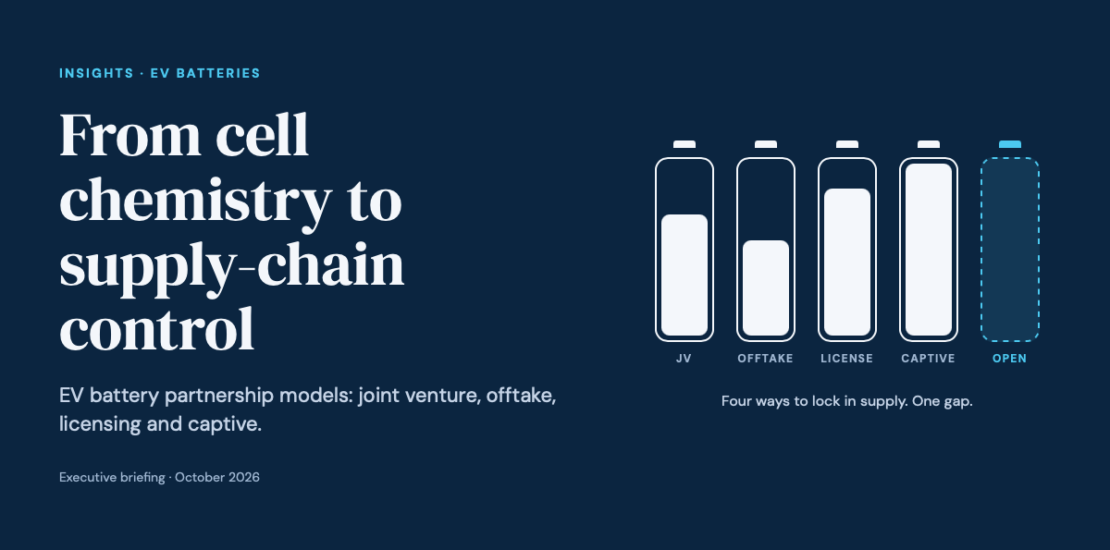
This piece compares the four models that matter to a board today: joint venture, offtake, licensing and captive production. It then maps who has locked in supply and who has not. Our reading is that the white space sits with mid-tier OEMs and emerging-market players such as Mahindra and Ather in India, where cells are still bought on short contracts and pack assembly is far ahead of cell security.
If you sit on the manufacturing side, that gap is a commercial opening. If you sit on the OEM side, it is a vulnerability with a date attached.
Why the cell is no longer just a component
For a decade, carmakers treated the battery like a bought-in part. That stopped working when the cell became the biggest line in the bill of materials and the biggest single point of failure.
Three pressures changed the maths. Chemistry has split: LFP is the low-cost default, nickel-rich cells still lead on energy density, and lithium-manganese-rich cells are the next contender. GM, for one, has said its LMR cells will be built at its Ultium Cells plant in Tennessee, with vehicles due in 2028 (InsideEVs). Betting on the wrong chemistry with the wrong partner is now an expensive mistake.
Politics has also moved in. Ford’s licensing arrangement with CATL drew a public letter from the US Transportation Secretary, who said he was “deeply alarmed” by the dependence, even though Ford owns and runs the plant (electrive). Who you partner with is now a regulatory question, not only a technical one.
And demand has been less forgiving than the plans. GM’s own exit from the Indiana venture was attributed to slower-than-expected EV growth (IEN). Fixed capacity commitments look very different when volumes arrive late.
The practical consequence: the partnership model is no longer a procurement detail. It is a strategy choice that sets capital intensity, technology access and exposure to politics all at once.
Four models, side by side
No model is best. Each one trades control against capital, and the right choice depends on how sure you are about your own volumes.
Model | Who carries the risk | Control over technology and supply | Speed to first cell | Live example |
|---|---|---|---|---|
Joint venture | Shared, in proportion to equity | High, but split with a partner | Medium: plant build plus governance | Stellantis and CATL: 50:50, up to €4.1bn, Zaragoza |
Offtake | Mostly the supplier, until volumes fall short | Low on technology, medium on supply | Fast | Gotion and Volkswagen: unified cells, 2026 to 2032 |
Licensing | The licensee builds and runs the plant | Medium: own the factory, rent the know-how | Medium | Ford and CATL: Michigan, Ford-owned |
Captive | Entirely the OEM or its group | Full, if the technology works | Slow | Tata’s Agratas: Sanand and Somerset plants |
Joint ventures buy you a partner’s process knowledge and a shared balance sheet. The price is governance. Two boards, two timelines and one plant that has to satisfy both. When strategies diverge, as they did for GM and for Ford, the venture becomes the thing you unwind.
Offtake is the lightest commitment. You sign a multi-year supply contract and let someone else build. It works well when you want speed and standard formats, such as Volkswagen’s unified cell. Note that Volkswagen is also Gotion’s largest shareholder, so even this “simple” deal carries equity underneath.
Licensing is the quiet winner of the last two years. You keep ownership of the factory and the workforce, and rent proven process know-how. It is also the most politically exposed, as Ford has learned.
Captive gives total control and total exposure. Tata is spending heavily on Agratas, and its first cells in India are not expected until 2027. That is a long wait for a mid-sized company with no group balance sheet behind it.
What the last twelve months taught us
Joint ventures are easy to announce and hard to keep. The unwinding that followed shows what actually breaks them.
In August, Samsung SDI bought out GM’s 49.99% stake in the Indiana venture, which had been due to start production in 2026 (electrive, IEN). The plant is expected to serve energy storage first. GM and Samsung SDI did sign a new agreement to develop a prismatic cell, so the relationship survived while the structure did not. It was GM’s second such exit: it left its Lansing venture with LG Energy Solution in December 2024, and booked a $6 billion write-down on its EV business in January 2026.
Ford and SK On ended BlueOval SK by mutual agreement, with each taking its own plants. SK On came out with sole ownership of a 45 GWh Tennessee factory (EVE Energy guide). One reported driver was chemistry: SK On is built around NMC, while Ford moved toward LFP and LMR (electrive).
We draw four lessons for an executive team:
- Chemistry mismatch kills ventures faster than finance does. If your partner is a specialist in one chemistry and your roadmap moves, the structure cracks.
- Demand risk is the real counterparty. Fixed-capacity plants assume volumes that did not arrive on schedule.
- The cell maker usually keeps the factory. When ventures dissolve, the supplier redeploys the plant, often to storage, and the OEM is left renegotiating supply.
- A memorandum is not a cell. Announcements such as the ProLogium and OPmobility solid-state module evaluation (SEC filing) are early steps toward OEM adoption, not secured volume.
The common thread is that the large OEMs could afford to try, fail and re-plan. A mid-sized company usually gets one attempt.
Who has locked in supply, and who has not
Put the deals on one page and a pattern appears: the OEMs with a secured position are the large, well-capitalised ones.
Stellantis, Volkswagen and Ford each hold a structure that gives them cells through the decade. GM keeps its Ultium venture with LG Energy Solution, and Tata has built its own captive supply in Agratas.
Everyone else is harder to place, because there is little to point to. In India, Tata, Mahindra and Ather build packs from cells bought elsewhere, and Ola is the only company making batteries right from the cell level (Zerodha Daily Brief, Cartoq).
The map below places each player by the structure reported in public sources. It shows what has been announced, not every private contract, so read the open-market box as a directional view rather than a census.
The four structures hold the large OEMs; the open-market box holds the buyers with the least protection.
The white space: mid-tier OEMs and emerging-market players
The gap is structural, not temporary. Every model that locks in supply asks for something a mid-sized buyer is short of: capital, volume or access.
We see three reasons it persists.
- Technology access is gated. Tata’s Agratas had no option to license LFP technology and is now trying to develop the process itself, while Reliance’s talks to license LFP from Hithium were reported to have stalled in January 2026 (Zerodha Daily Brief). If groups of that size struggle to get a licence, a mid-tier OEM has little chance of getting one on its own.
- Joint ventures and captive plants need scale. Both assume a volume that justifies a gigawatt-hour factory. Even Tata’s Sanand site is a 20 GWh plant that is not expected to make cells until 2027.
- Suppliers favour anchor customers. This is our view rather than a reported fact: cell makers allocate early capacity to the buyers that bring volume and equity, which leaves smaller buyers on spot-style contracts.
The exposure is clearest in India. Tata’s competitors have long had to buy batteries and components from market suppliers while Tata moves toward vertical integration (Digitimes). As far back as 2022, Mahindra’s chief executive said the company could consider investing in a cell maker to secure future supply (Reuters via Euronews). Intent is not the same as secured volume.
South-East Asia shows the alternative. VinFast has signed agreements with Gotion, ProLogium and StoreDot, stacking several relationships instead of betting on one (WapCar). It is a useful template for emerging-market players: more partners, shorter commitments, and an early route to local assembly.
What this means for manufacturers looking at India
If your buyers are the unpartnered ones, your route to market matters as much as your product.
We work with manufacturers across Europe and South-East Asia who want to reach Indian buyers, and the same pattern keeps appearing. The large OEMs negotiate directly, through joint ventures or long contracts. The mid-tier does not. These buyers are spread across passenger cars, commercial vehicles and two-wheelers, and they tend to be reached through a trusted local partner, not a head-office tender.
That makes the distributor decision a strategic one. A few points we would put in front of a board:
- Match the partner to the model. A distributor who can move standard cells on short contracts is a different business from one who can support module and pack integration. Pick for the buyer you want, not the one you already have.
- Look for access, not just reach. The useful question is which unpartnered buyers a distributor actually serves today, and how long they have served them.
- Test the balance sheet. Mid-tier buyers often need flexible volumes. A distributor who can hold stock and absorb a slow quarter lowers the risk on both sides.
- Plan for the bridge years. Domestic cell output at scale is still ahead. Agratas, for example, expects its first Sanand cells in 2027, so imported supply has to carry buyers until then.
None of this replaces the big structural deals. It sits alongside them, in the part of the market that the large deals leave open.
Five questions for the board
Before choosing a model, answer these honestly. They decide which structure you can actually carry.
- Which chemistry are we betting on, and can our partner follow us if we change? Chemistry mismatch was one reason a major venture ended.
- What volume can we commit to for five years? Joint ventures and captive plants need it. Offtake and licensing need less.
- Whose technology and ownership are we exposed to? Political scrutiny now reaches licensing and supply, not only plants.
- What happens if a partner redeploys its factory? Several cell makers have shifted capacity toward energy storage.
- Who reaches the buyers who have not yet partnered? For suppliers, this is the commercial question that decides where the next contracts come from.
The partnerships that last will be the ones chosen for fit, not for headlines. For mid-tier OEMs and emerging-market players, the next twelve months are the window to secure that fit before the large buyers absorb the available capacity.
Sources
All pages below were reported as of 8 October 2026.
- InsideEVs: GM confirms LMR cell plant
- electrive: Washington and Ford’s Chinese partners
- electrive: GM exits Samsung SDI joint venture
- IEN: GM exits $3.5B battery plant venture
- electrive: Ford to produce first LFP cells with CATL licence
- EVE Energy: Top 10 EV battery makers, 2026
- Automotive World: Stellantis and CATL joint venture
- CnEVPost: Gotion unified cells for Volkswagen
- SEC filing: ProLogium and OPmobility MoU
- Cartoq: Tata’s Agratas battery plants
- Zerodha Daily Brief: India’s EV battery dependence
- Digitimes: Tata and local battery supply
- Euronews: Mahindra and cell supply
- WapCar: VinFast battery partnerships
Contact us for any of your queries or submit a business inquiry online.